Many studies have been made during the past few years about the impact of light on different aspects of human life. Color preferences, sales results, health and well-being are very much in focus. Zumtobel Lighting and the Gruppe Nymphenburg, for example, found that the “power of unconsciousness” is an important marketing tool, also in respect to lighting situations. The so-called Limbic® approach, developed by the Gruppe Nymphenburg, allows characterizing people in regards to their lifestyle preferences. Predictably, the various types also prefer different lighting situations. Research showed that the diverse types also had preferences for different shops and that shops that were equipped with light that pleased these personalities had a positive impact on sales. This study for boutique and fashion stores mainly focused on contrasts and CCT, assuming the use of high CRI lights. In order to completely satisfy these requirements the right light sources need to be chosen. That’s when the new approaches from Lumiled’s come into play. With the new series, Lumileds is convinced it has the answer for providing light sources that make various products more pleasing to the eye with the best suitable color point. In addition to that they also provide most products in different CoB packages with different power ratings and different CCTs to satisfy customer needs. The four technologies, CrispWhite Technology, CrispColor Technology™, FreshFocus Technology™ and AtmoSphere Technology™, each have a very different focus but all of them have one design rule in mind: While making specific colors look more pleasing to the customers the overall spectrum has to be tuned so that the other colors maintain the best possible appearance. According to Lumileds, their own phosphor development center in Aachen, Germany enables them to provide specific spectral tuning. To explain the advantages in detail it might be good to have a look at the background and the single technologies and products.
The new Approaches in General:
Where applicable, the spectral distribution was tuned to score high for all relevant light quality indices, CRI, GAI, CQS, and TM-30 Rf and TM-30 Rg. The product portfolio covers all CCT and lumen packages that are commonly used for the foreseen application and luminaire types.
CrispWhite Technology:
This is basically an update in efficacy of the already existing product. It is only available with a CCT of 3000 K. The available nominal lumen packages cover 651 lm to 4,215 lm as 1202s to 1211 CoBs.
The effect of this light source is based on a near UV / purple LED that activates the fluorescent whitening agents that are used in white clothes and some washing detergents. The activated brighteners absorb this light and emit a slightly more blue light, usually in the range between 430 nm and 480 nm. This makes the white appear brighter, hence whiter.
CrispColor Technology™:
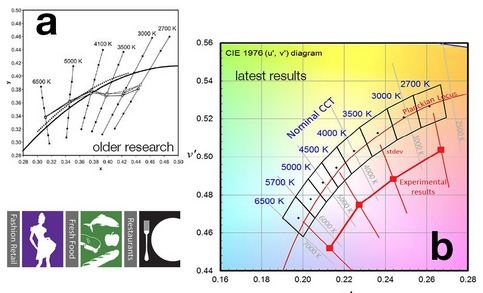
For this technology the broadest range of products with CCTs from 2,700 to 5,000 K and nominal lumen packages from 653 to 6,766 lm are available as 1202s to 1216 CoB packages. The new approach is backed by Yoshi Ohno’s research about color preferences, “Vision Experiment on White Light Chromaticity for Lighting” [1]. While earlier research from M. S. Rea,* J. P. Freyssinier, published in White Lighting, Volume 38, Number 2, April 2013, showed a preference for white light below the Black Body Line (BBL) for CCTs below 4000 K and slightly above BBL for all CCTs above 4000 K (Figure a), Yoshi Ohno’s later and more detailed research demonstrates that in most situations a white point below the BBL is preferred (Figure b). Lumileds designed all CCTs of this series according to these findings. Nevertheless, the proper spectral tuning gives high scores for all color quality indices. When looking at the spectrum, at first blue and red look very accentuated and in comparison to other white products, green and yellow seem to be slightly suppressed. In fact, this impression is not accurate. When compared with the spectral distribution of sunlight of similar CCT, one can see that the green and yellow range follow the curve of natural light very closely. The two peaks of red and blue naturally remain. Due to the V-Lambda curve, the greens and yellows are not compromised, and it means just a small over-saturation of red and blue for the human visual system. This is what makes colorful scenes more vivid and pleasant especially since reds usually look dull under many white LED light sources.
FreshFocus Technology™:
The products are available with different CCTs that depend on the illuminated product. They will be made available as 1208 and 1211 CoBs, providing approximately 2,000 to 4,500 nominal lumens, depending on the application. While the “Red Meat” and Marbled Meat” products can hardly be assigned to any CCT, the “Bread & Pastries” version has a CCT of 2,700 K and matches the BBL almost exactly, while the “Fish” CoBs match 6,500 K on the BBL exactly. One could assume that the latter two products are just high CRI products. This is true, but special focus was put on the design of the light spectrum for these high CRI CoBs. As an example, for 6,500 K CCT, products that are rarely available with high CRI, the R9 index (saturated red) is usually very poor and often even negative. For the “Fresh Food – Fish” Stylist product it is still above 90.
AtmoSphere Technology™:
This candlelight-like LED light source with a CCT of 2,200 K offers a comparatively high color rendering due to spectral tuning. It is available in 1202s to 1216 form factors.
Conclusions:
At first glance this this doesn’t seem to be a big deal because other companies have been providing specific products for these applications for a while but the innovation is in the detail. Summary of the innovation:
• Color points below the BBL
• Optimization of the whole spectrum and not just an adaptation to improve the appearance of one or two colors for an application
• High scores for all important color quality metrics This could only be achieved by thoroughly adjusting the phosphors and combining the right components for the LEDs. The future will prove the market acceptance and the results.